An Caoránach
“We don’t have connections with dragons here in Ireland”, I found myself saying to a friend, “in the same way they do in Wales and other countries”.
As soon as the words came out of my mouth, I found myself questioning if the words I had were spoken were actually true.
Then I remembered that all across Ireland there are places names are numerous reference to An Péist, or ollphéisteanna, which means “great worms” or “mighty reptiles”. The Oilliphéist (Irish: ollphéist, meaning ‘great worm’ or ‘monster’) is a sea serpent or dragon-like creature in Irish mythology and folklore. These monsters were believed to inhabit lakes and rivers across Ireland and feature in many legends involving battles with saints and heroes.
As I delve deeper, I find that our dragon culture has been deeply suppressed, but it is very present in our old culture.
“… No country in Europe is so associated with the Serpent as Ireland, and none has so many myths and legends connected with the same… “ Irish Druids and Old Irish Religions – James Bonwick, 1894.
The River Shannon Legend
One famous tale recounts an Oilliphéist’s encounter with Saint Patrick. Fearing the saint’s mission to drive out all serpents, the creature fled, carving the route of the River Shannon, Ireland’s longest river, in its haste.
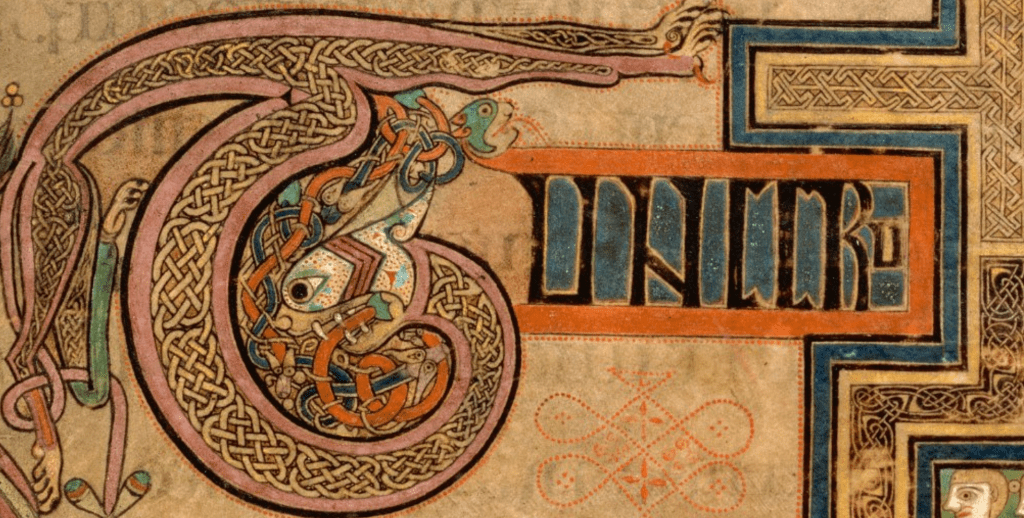
An Caoránach
On my wanders around Ireland, and I like to wander, with no fixed plan, called where I may be called, I found myself at the ancient pilgrimage site of Lough Derg, Co. Donegal.
There I met a red haired, bearded, gaeilgeoir seanachaí, a traditional storyteller, very familiar with the old folklore and place names of Ireland. The told me the story of An Caoránach, the dragon that supposedly inhabited Lough Derg (it is also associated with Lough Muskry in the Glen of Aherlow)
In Irish folklore, Caoránach (sometimes called Caol) was an Oilliphéist and said to be the mother of demons, banished by Saint Patrick to Lough Dearg in Donegal, Ulster.
According to an earlier legend, Fionn mac Cumhaill and the Fianna were tasked with slaying a hag in the Lough Dearg region. Struck by an arrow from a great distance, her body was lost. When the Fianna finally found it, they were warned not to break her thigh bone, as it would release a dangerous monster.
However, a man named Conan broke the bone, releasing a small hairy worm that quickly grew into a large monster named Caoránach. This monster began devouring the cattle in Ulster. After most of the cattle were eaten, the locals blamed Conan. Enraged, he entered the monster’s mouth with a sword and killed it. Lough Dearg is said to be named after the blood from Caoránach, which stained the rocks red.
In a more Christianized version of the story, Saint Patrick arrives in the area and is informed about the monster. He confronts and argues with the beast before slaying it, and its blood dyes the lake red. In some versions, Saint Patrick then declares the lake should be called Lough Derg. In other variants, Saint Patrick fails, and the monster still inhabits Lough Derg to this day.
The tale bears an eerie similarity to that of Beowulf. After defeating the monster Grendel, Beowulf ventures to the lair of Grendel’s mother, sometimes described as the mother of all monsters, located beneath a lake. Beowulf dives into the underwater cave, slays Grendel’s mother, and returns to his men triumphant. Could these stories share a common origin?
The symbology of the mythology is striking.
If dragon energy was meant to represent the kundalini, feminine energy of the Earth- why were these great mythological hero’s from many cultures killing the dragon? Do they tell us of the end of the feminine goddess cultures across Europe around the time of the Iron Age? It is also worth noting that the Irish dragons are associated with water- rivers and lakes.
The strangest part of this story is yet to come. I had never heard the story of An Caoránach before that day with the Seanachaí on Lough Derg.
The same day as first hearing the story, on returning to the matrix, the modern world, after a few days offline, I checked my phone, and one of the first messages was from someone I know who is living in Ireland, not from here, who is connected to these things.
“I was wondering if you could help me with the pronunciation of this gaelic name?” he asked me.
And the name he wanted help with, was…
‘Caoránach’


Leave a Reply